

Working Paper #003 - Withering on the Vine: A Formal Theory of Modern Hiring Practices and Labor Market Failures
Research Abstract: This paper develops a dynamic model of job search in which hiring experiences can alter the applicant state from which subsequent search is conducted. The worker’s state includes liquid assets, beliefs about application success, accumulated negative hiring experience, and psychological search capital governing how effectively raw effort is converted into hiring outcomes. Rejection, employer nonresponse, prolonged screening, repeated assessments, and other unrewarded demands deplete search capital, raise application costs, and reduce perceived returns to search. Declining assets also increase financial pressure, lowering search effectiveness before the borrowing constraint binds. These mechanisms generate applicant-side negative state dependence in the optimized job-finding hazard even when worker productivity and the vacancy distribution remain unchanged. They may also redirect search away from identity-relevant and, under an additional alignment condition, higher-match vacancies. Financial depletion lowers the reservation job value and may induce acceptance of poorly matched employment, entry into hiring-bypass work, or non participation. If accepted employment is sufficiently burdensome, reduced on-the-job search capacity can make mismatch persistent. Because firms need not internalize how screening burdens affect applicants’ subsequent search elsewhere, individually rational hiring practices may prolong unemployment and reduce matching efficiency.
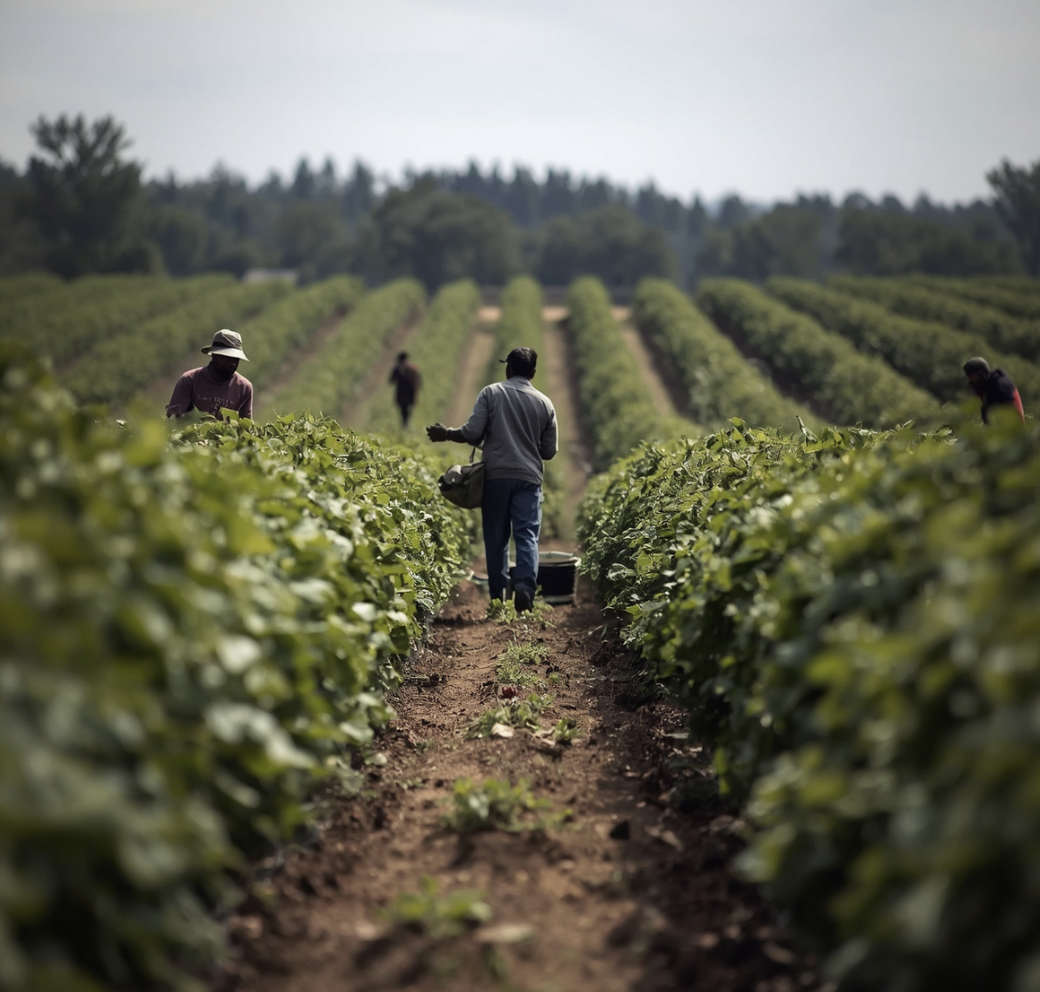
Working Paper #002 - Concentration at the Top: Labor Access and Agricultural Production in the United States
(Versión en español disponible)
Research Abstract: The rapid expansion of the H-2A temporary agricultural visa program has coincided with declining domestic farm employment and persistent specialization in U.S. agricultural production. This paper creates the first systematic concentration dataset for the H-2A labor market. This paper also examines how structural access to H-2A labor relates to patterns of agricultural concentration across U.S. states. Using newly constructed labor and commodity concentration measures and state-level panel data from 2015 to 2024, the analysis documents systematic co-movement between employer concentration in the H-2A program and concentration in agri- cultural production. This relationship is highly asymmetric: extreme commodity dominance is associated with concentration of H-2A employment at the single largest employer, but broader measures display no systematic relationship. The association is concentrated in thin markets where a single crop and a single employer jointly dominate, and attenuates in larger agricultural states. States with higher employer concentration also exhibit systematically lower prevailing wages, a pattern robust to excluding the largest and smallest H-2A states, though the within- state wage relationship is fully absorbed by annual federal wage floor updates. Labor concen- tration declines across all metrics as H-2A scale increases, suggesting dominance weakens as participation expands. These findings provide a descriptive framework for understanding where H-2A labor and production concentration are linked in U.S. agriculture and where institutional wage floors rather than market competition determine worker compensation.